

In our village everyone feared debts, “Kaateri,” the blood-drinking ghost, and also the overflowing river during monsoon.
But I feared only one thing—Kaveri.
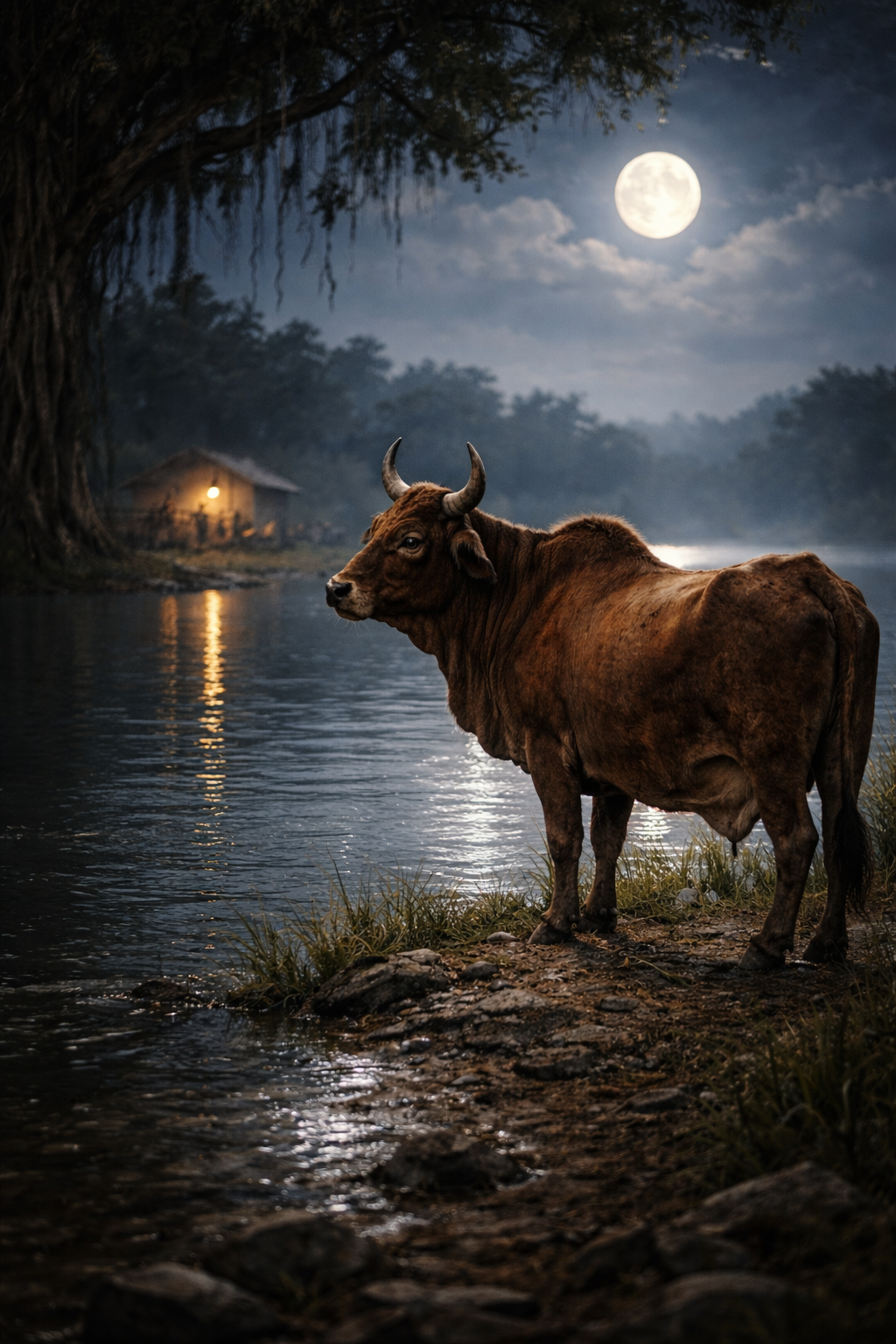
Kaveri—our desi cow. Brown, thick skin, old, and slow-moving, but eyes so sharp that they made grown bearded men lower their voices.
She belonged to Appa and before him Thatha (Grandpa). People say cows and elephants remember faces. Well, Kaveri remembered intentions.
Often she would stop suddenly and refuse to move. Not stubbornly, I must say, but decisively. As if the universe was trying to tell something only to her.
We would often laugh at her.
“She is old,” my uncle guffawed. “Let her enjoy her moods.”
But I knew Kaveri didn’t do moods. She gave warnings.
One day when I was walking back from grazing, she froze suddenly. Her ears were almost up, hooves dug in, and her eyes lit up as though she had discovered something. No amount of pulling worked. As I waited, I heard a low murmur of voices. Men arguing behind the large banyan tree that hid them well.
A moment later they scattered. News spread that night that someone had been beaten near the grove and left unconscious.
I couldn’t tell anyone about Kaveri stopping. In villages coincidences are safer than truths.
The real drama started when she came home. She didn’t drink water, and every time my cousin Bhola came close, she kicked her bucket. Bhola laughed it off.
“Looks like she doesn’t like city smells,” he joked, lighting his beedi.
Every time Bhola opened his mouth to speak, Kaveri’s tail lashed like a whip.
Bhola had suddenly returned after 12 years to the village. Too many questions, too much money. He said he had come to sell off ancestral land. The same land bordering the riverbank is worth nothing officially but worth a fortune quietly…
One night Kaveri ran. Yes, that old brown-skinned, slow-moving desi cow ran.
She broke her rope.
I woke to the sound of frantic mooing; it wasn’t loud but definitely urgent.
The kind of sound that drills into your bones. I got hold of the torch and ran behind her.
She stood near Bhola’s room.
He was shouting inside. Whisper shouting on the phone.
“If you do not come tonight, THAT’S IT.”
“Yes, I’ve been telling you the papers are ready…”
Just then Kaveri stamped the ground hard this time.
Bhola yanked open the door and froze.
I laughed nervously. “Looks like she is guarding the house now.”
Bhola smiled, but his eyes had a different story to tell.
“Tie her properly; animals do not know their limits.”
Kaveri backed a bit and lowered her head as he shut the door on our faces frantically.
That’s when I realized something was wrong.
The next day, the river inspector along with two men pretending to be land surveyors came. That night, the village dogs barked without a pause, and Kaveri did not lie down even once.
She broke loose again.
This time I followed.
I was ten steps behind her as I saw her walk towards the riverbank.
The moonlight silvered her back. Near the old shed voices rose.
Bhola, the strangers with their maps and bags of money. Words like “signed, buried, and finished” were exchanged.
Then in a few seconds I heard a loud scream.
I ran.
One man lay on the ground holding onto his leg in pain. The shed was smashed and had fallen on him while Bhola stood there shaking.
Kaveri stood firm.
The man cried in intense pain. “This cow—sh—she charged.”
Bhola shouted, “Shut up.”
The police arrived before dawn. Turns out the men were forging land records and planning to divert river water illegally. Of course, Bhola wasn’t “Bhola” at all. He was the middleman.
The shed was their safe space.
The next day no one questioned how the shed broke or why the cow’s horns had fresh mud and blood.
Villages accept what protects them. This was divine intervention.
A week later Kaveri stopped eating; she refused fodder and water and stood facing the river every evening—calm and silent.
Her ears were up, and her eyes still shone as bright as the star.
The village vet said it’s her age.
On her last night she rested her head on my lap.
Her breath was warm and steady, and she was ready to let go.
She didn’t wake in the morning.
We buried her near the banyan grove by the river, where she stood protecting and watching it even during her last days.
Now when people walk past the place, they lower their voices. Some say they often hear hooves at night. And the river hasn’t crossed its banks even during the heaviest monsoon.
As for me, I learned a great lesson.
In villages gods are often seen in living forms, some protecting us from Kaateris and some brown-skinned slow walkers seen chewing slowly and standing their ground and saving everyone without asking to be believed.


