

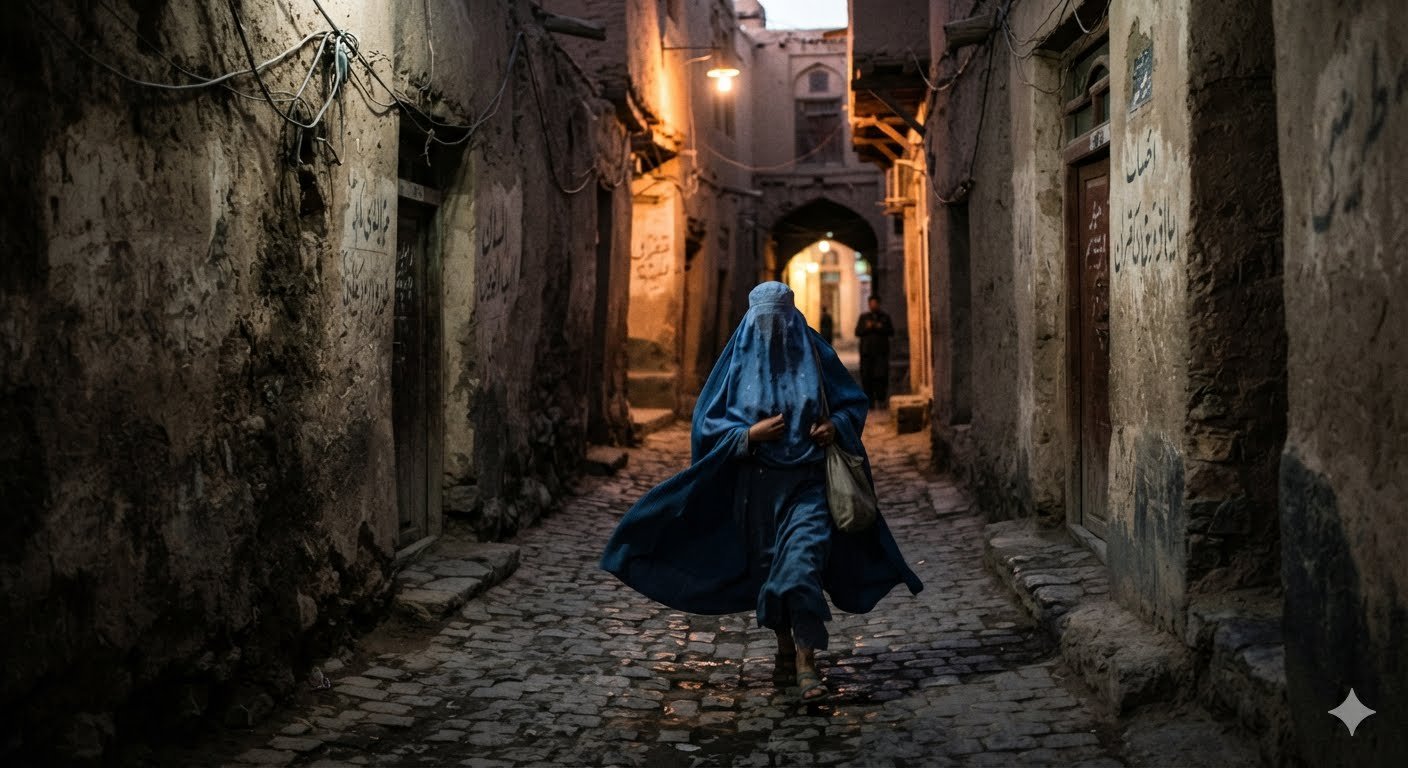
The streets weren’t safe after dawn. They weren’t safe after dusk either; women were safe only within the confines of their kor*.
Roya closed her eyes and raised her palms to her shoulder level, muttering the opening Takbeer*.
Hearing Baba’s* loud spluttering cough, she bolted upright. Roya had not slept a wink last night. Sips of warm water with crushed ginger and honey did little to subdue his coughs. His medicines were over, and she couldn’t possibly go out into the streets alone.
“Ya, Allah! I really hope Arbaaz will be back home soon.” She raised her palms towards the sky. Arbaaz, her brother, worked in a textile factory on the outskirts of Herat and visited home once a week.
Her large, almond-shaped, blue eyes fell on the old clock on the cracked wall. In another hour, the sun would be up. She hoped against all odds that her Baba would be up, too.
“Come what may, don’t go out alone. Once Arbaaz is back, he will take me to the doctor,” Baba gasped. She noticed how much he had aged over the years. He was suffering from a lung infection, and the high doses of medicine had weakened him. His pale eyes sagged more out of fear for his daughter’s safety than due to prolonged illness.
Their lives had changed after the Taliban had taken over the reins of their country. Women had to cover their bodies with a chadari*and couldn’t go out without a mahram*. They were not allowed to go to school or pursue any profession. Roya was happy that her Maman* was long gone before she could see the sad plight of her Afghan sisters.
Roya had completed her degree in Literature and was eager to find a job when her dreams crumbled. But she was not the one to give up. She tutored young girls from her neighbourhood in small batches. Their muffled tones, long chats over the phone, and their charting out action plans on the sly piqued Baba’s curiosity. “They are pursuing online courses, Baba.” Roya would dismiss his raised eyebrows with a wave of her hand.
She had seen her friend Arezo burned alive by the Taliban guards from her window for being a women’s activist. Baba and Arbaaz had covered her mouth with a cloth and held her arms firmly to keep her from yelling or rushing to help.
The thought made Roya’s eyes brim with tears. The call to the muezzin* broke her reverie. She had to rush to the hospital to get medicines. She couldn’t see him suffer.
Roya decided to quietly slip in through the narrow alleys before the first rays of the morning touched the streets.
As she pulled her chadari* over herself, her heart raced. She hunched her five-foot frame lower and sneaked out into the streets as her Baba’s loud coughs echoed through the house.
The narrow mud brick alleys, too, like Roya, were shrouded in cloaks of darkness. The aroma of fresh nan-e-afghani*, rising in the hot clay walls of the tandoor, escaped from the shanties. Muffled clinking of donkey bells broke the stillness of the air.
Roya sprinted, pressing her veil firmly over her face. Her heart thudded against her chest. It was difficult to say which emotion reigned: fear or suppressed anger. She entered the hospital and bought Baba’s medicines, ignoring the surprised looks from the male nurses.
She darted through the dark alley when a strong gust of wind pushed her veil backwards, revealing her face. Before she could react, she was surrounded by the Taliban guards. “Tu zan-e badbakht*, how dare you defy orders?” The guards hollered.
Roya’s face was covered in sweat. Her fingers quivered, but she held on to the medicine bottles.
“Cover your face, now!” The guards barked in unison. Roya stood still. Unbeknownst to her, the frustration and angst she had suppressed for years surfaced. Her red eyes widened, and her nostrils flared as she glared at the men.
With one quick sweep of the end of his rifle, the guard hit her hand. The medicine bottles broke, and the dark liquid spilt out.
They pinned her down and butted her with rifles. They kicked and punched her, but not a word escaped her lips. She neither covered her face nor lowered her gaze. Thick red blood flowed, drenching the dusty streets just like Arezo’s blood had. Roya could hear windows creaking, but not one door opened.
Roya’s body was battered beyond recognition. As life ebbed from her, in her mind’s eye she could see the young women she tutored, taking to the streets of Herat, the sun’s rays radiating across their faces. She smiled.
The Taliban guards were used to hearing women scream and plead for forgiveness. The fury in Roya’s eyes, the grit on her face, and the smile on her lips perplexed them.
They thought they had silenced one more murmur. But not even in their wildest dreams did they know that Roya had ignited an ember of resentment among young women against the Taliban. They had secretly secured support from the human rights organisation. The day was not far when the flicker would erupt into flames and burn the Taliban rule into ashes.
The streets would finally be safe for women.
The sun rose, filling the dark alleys with a splash of amber as if to say ameen*.
*********************
Glossary:
Dari (Afghan Persian language)
Kor: home
Takbeer: a fundamental part of daily prayers
Baba: father
Ya Allah: Oh God!
Chadari: a head-to-toe garment worn by women in Afghanistan
Mahram: a male guardian
Maman: mother
Muezzin: The Islamic call to prayer
Nan-e-afghani: a traditional Afghan flatbread
Tandoor: a clay oven
Tu-zan-e-badbakht: You wretched woman!
Ameen: So be it!




This is wonderful, you made me travel with Roya, sad truth, hard to accept, you’ve taken the simple flow, bt the suspense was ?