

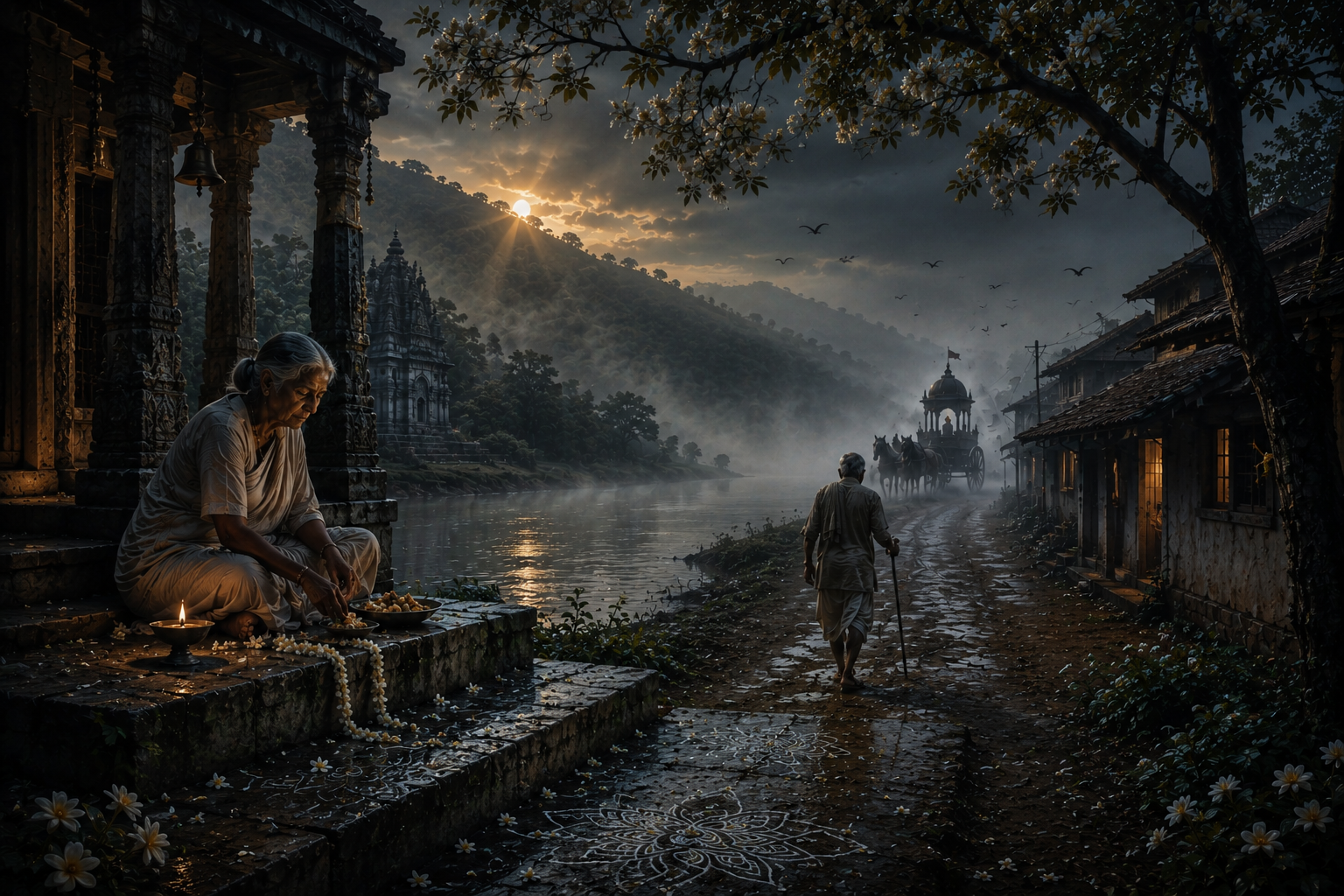
The Streets Weren’t Safe After Dawn
The morning sky glinted as the early rays broke over the horizon. An eerie silence hung over the village of Sitapur. No birds chirped. Every house was bolted, its windows closed. The last flicker of lamplight died.
No one waited to see the sunrise. The morning began as if carrying the scent of the night. A thin film of dust swirled and remained suspended in the air. The slow rumbling grew clearer. The chariot, they said, had come. It came every Shukla Dashami, carrying a silence no one dared question. Whoever questioned it never remained the same.
Only one person waited for the sun to rise, for its rays to reach the temple steps.
On the slopes of Mahendragiri stood a weathered temple beside Mahendratanaya. Its waters flowed seamlessly through the night. But during the day, they slowed, and the colour turned grey, as though ashes floated upon the surface.
The river carried the story silently, like Raji Amma, the temple priestess.
She knew what the mountains said.
Every day, she strung shiuli flowers into a garland for the deity. Her fingers drew patterns on the ground with rice paste as she continued chanting.
She squinted at the roofless hut in the far east. Her wrinkled hand shaded her eyes from the harsh rays.
“Mangalu,” she called again.
Mangalu limped towards the foyer, his face expressionless. His walking stick found the way before him.
“Here.”
Raji Amma placed some food on a plate and left it on the steps. He bent, his forehead touching the floor. “Jai Maa Thakurani.” The temple bell rang. He picked up the plate and limped away.
“Give it to her.” Her voice faltered. She watched him disappear beyond the mountains. Almost every day.
Then Dashami arrived.
The sun’s slim rays seemed to halt, like the prayer on Raji Amma’s lips. Her hands remained folded as sweat trickled down her face. The shiuli flowers lay strewn across the floor – withered, colourless. The floral patterns were smudged, as though someone had walked over them. The temple door remained half open.
Raji Amma’s voice rattled through the thick silence. Her body suddenly gave way, shaking violently. Mangalu watched her, breathless, as her eyes rolled back and her long tresses fell across her face.
“Maa asuchi… Maa asuchi…” she whispered through gritted teeth.
He knew what those words meant. Fear tightened his throat, but his foot was already moving.
He hurried through the serpentine roads towards the village, shouting, “Maa Asuchi! Maa Asuchi!” without looking back. His frail body raced like the wind; his cries echoed in the valley.
The windows shut. Voices stopped. Sitapur went quiet.
Mangalu slipped behind the ancient shiuli tree, his heart pounding and his gaze fixed on the empty road.
Down below, a woman’s hand reached beyond an open door. At the first rumble, it retreated. The loose end of her saree was pulled back immediately.
Then…
A cloud passed overhead. Dust gathered as though the unseen chariot rolled forward. It creaked. The ground shook. He saw fresh wheel marks on the wet sand and the same footprints.
Nothing moved except the leaves of the shiuli tree. The imprints faded only after the flowers drooped. A chilly breeze swept through the village.
Mangalu shivered. Years ago, his sister Tarini had unknowingly stepped on those footprints. She had fainted, waking later to similar convulsions. Her screams had pierced through the darkness.
He closed his eyes, gripping the stick tighter. Slowly releasing his breath, he stared at the dimming sky.
On the mountains, Raji Amma woke from the trance, exhausted and weak. She did not know what had happened while she was lost within it. An unnamed fever gripped her body.
She looked towards the deity. Her eyes carried the grief she believed wasn’t hers. Slowly, she withdrew her hands from the strewn shiuli flowers.
Mangalu walked back to the hills, his steps slow and heavy. He stopped in front of the temple’s threshold. Their eyes met for a brief moment.
Raji Amma whispered, “Aye re.”
“Did it happen again?”
He nodded.
His gaze settled beyond the river on the lone hut. A song played in his mind; he had heard it all his life.
Thila eka Rajkumari,
Nadi kule chaluthila
Phula pari hasuthila…
As a child, Mangalu had once asked his mother what the song meant.
“The princess of Sitapur would fall ill, her body twisting uncontrollably, eyes rolling back until she collapsed,” she had said. “Then the king’s beloved queen died following one such seizure. Grief consumed him. Blinded by fear, he sent the princess away, beyond the mountains.”
Some believed she lived alone in the hut, gathering shiuli flowers. No one met her except the man who brought her food from the temple. They say she spoke to the river. And it listened.
One morning on Shukla Dashami, her body shook so violently that the tremors were felt across the village. Then they stopped. Forever. The flowers floated down the river. No one saw her again.
Perhaps she comes. Maybe she has never left.
“Mahendratanya”
Glossary
- Maa asuchi (Odia) – Goddess is coming.”
- Thakurani – The temple deity
- Aye re (Odia) – An expression of sorrow
- Folk Song (Odia)
“There once was a princess,
Who walked along the riverbank,
Smiling like a flower.”


