

“Come to eat, the spread is already there and they have already shot the video,” my friend Sukumari called me.
I shifted my gaze from my mobile phone to her face. Sukumari was smiling; she was looking gorgeous in her checked black and red saree with her trademark smile and neatly braided long dark mane touching her hips.
The place was decorated neatly- the camera and lights were set up, and indigenous foods were arranged on the table. The special focus was on red ant dishes- red ant chutney and dessert and in a glass bowl with a frozen ant on top. It looked as if it were alive. For a moment, I felt as if a close friend was being served in the dish. I consoled myself. Sukumari gently pressed my palm, as if she could understand my feelings.
I remembered our first meeting when my dad got a transfer to a forest area and I had to join the local school reluctantly. Though I could make new friends easily, it wasn’t easy for me to mingle with the children in the class and join their games and giggles. The language they spoke was a bit strange, which kept me away from their group.
Watching them play, I kept my hand on a guava tree. Suddenly, I felt a sting on my wrist and screamed. All of them stopped playing and looked at me. A girl wearing a red frock came running towards me and asked, “What happened?”
“Something stung me,” I was almost crying.
She looked at my wrist, laughed and said, “It’s a Kai– red ant, see it’s crawling on the tree. Don’t worry, apply a little saliva. You would be fine.”
I did so and forgot the pain. I don’t know how I slowly became friends with her. We sat next to each other and chatted often.
She noticed that I was fearing the red ants after that sting. As a friend, Sukumari tried to bridge the gap between the red ants and me.
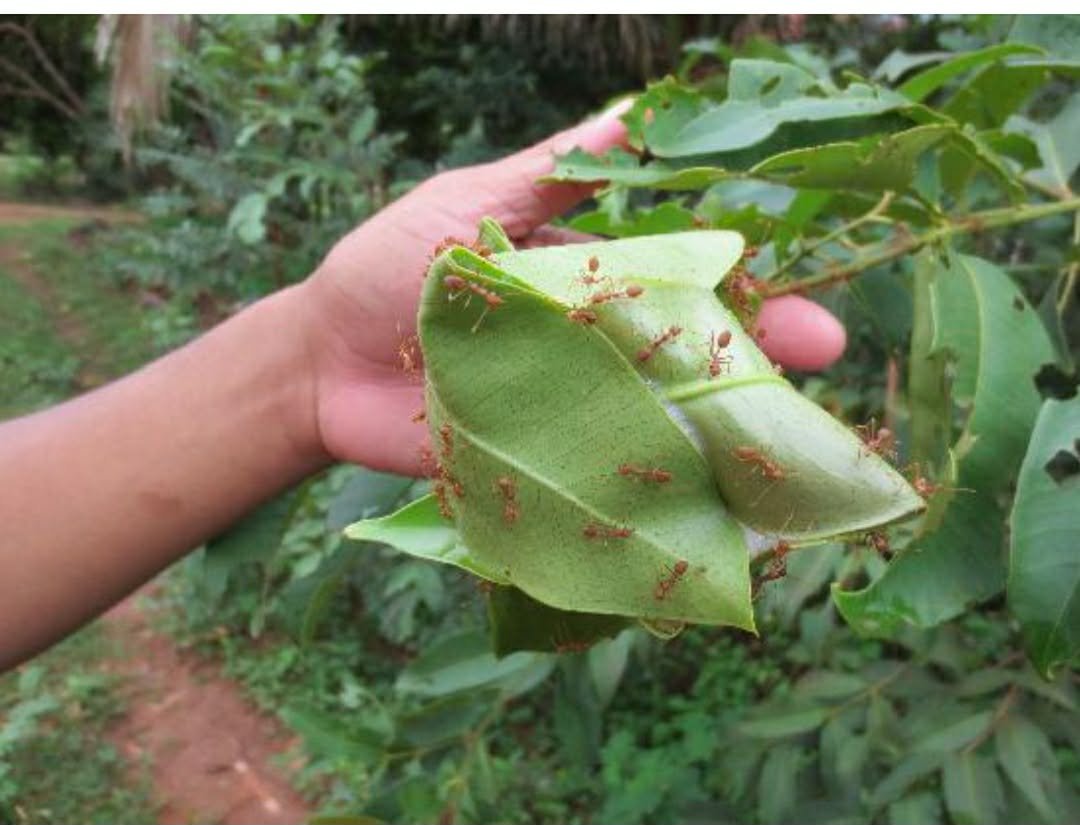
During class breaks and after school time, we ventured to watch the red ants crawling on the trees, their disciplined walk in a queue, and their beautiful nests made from live leaves kept me fascinated. I observed them more and more, and slowly I felt as if their struggles became mine. I felt sad when a little rain or strong wind would destroy their small nest. I was awe-struck by their unity, teamwork and discipline; they all lined up to collect and save food. Due to their small size, a blade of grass would feel like a tall tree, and a few drops of water could flood their way. I studies them to understand the relationship among them.
“Poor ants, they cannot see, can only feel. Their life is so vulnerable; they can die if crushed under the feet of any animal,” I would think and share with my family.
“You are thinking so much about them, better concentrate on your studies.” They would dismiss my feelings.
Sukumari showed me the method of making kai chutney out of red ants, which is a local delicacy that all of them savour. She had also offered me. But I was always scared to try that. Moreover, I was scared of mummy- what if she finds out that I have eaten them? So I never tried.
As I had developed both curiosity and a liking for those red ants, I watched them for hours, sometimes with Sukumari and sometimes alone.
How they travel, collect food, make their nest and how they are caught to be served as chutney on the local plates. All fascinated me.
As I grew up, I had to go back to the city for my education and then a job. But the fascination for red ants remained intact.
In a conference, I met Dr Murali, who was doing research on indigenous foods.
“Would you like to do an empirical study on the dishes made from red ants?” I suggested.
He nodded.
Rest fell in place and I was the associate for his project. I revisited my childhood memory and contacted Sukumari. She was living at a nearby village after marriage and was happy to receive us.
Apart from ant chutney, ant egg chutney we experimented with frozen ant dessert.
“The red ant is finally your friend now. Will you try some ant chutney now?” Sukumari said.
“No, ants are my small philosopher and guide that gave a meaning to my education. I can’t eat them.”
We both smiled.
The red ant dishes and facts were covered by the media.
“I especially thank Minakshi for her initiation of this project and her knowledge about red ants. Red weaver ants are rich in nutrition, including high levels of protein, calcium, zinc, and vitamin B-12,” Dr Murali was giving a presentation while the red ants lie unmoved on top of ice-cream in the glass jar and as chutney in a bowl.
*****


