

Reality has become so creative that satire may have to take a quiet bow and recede into the shadows. Every morning, newspaper editors no longer ask, “Is this true?” They ask, “Can we print this without readers assuming it’s fake?”
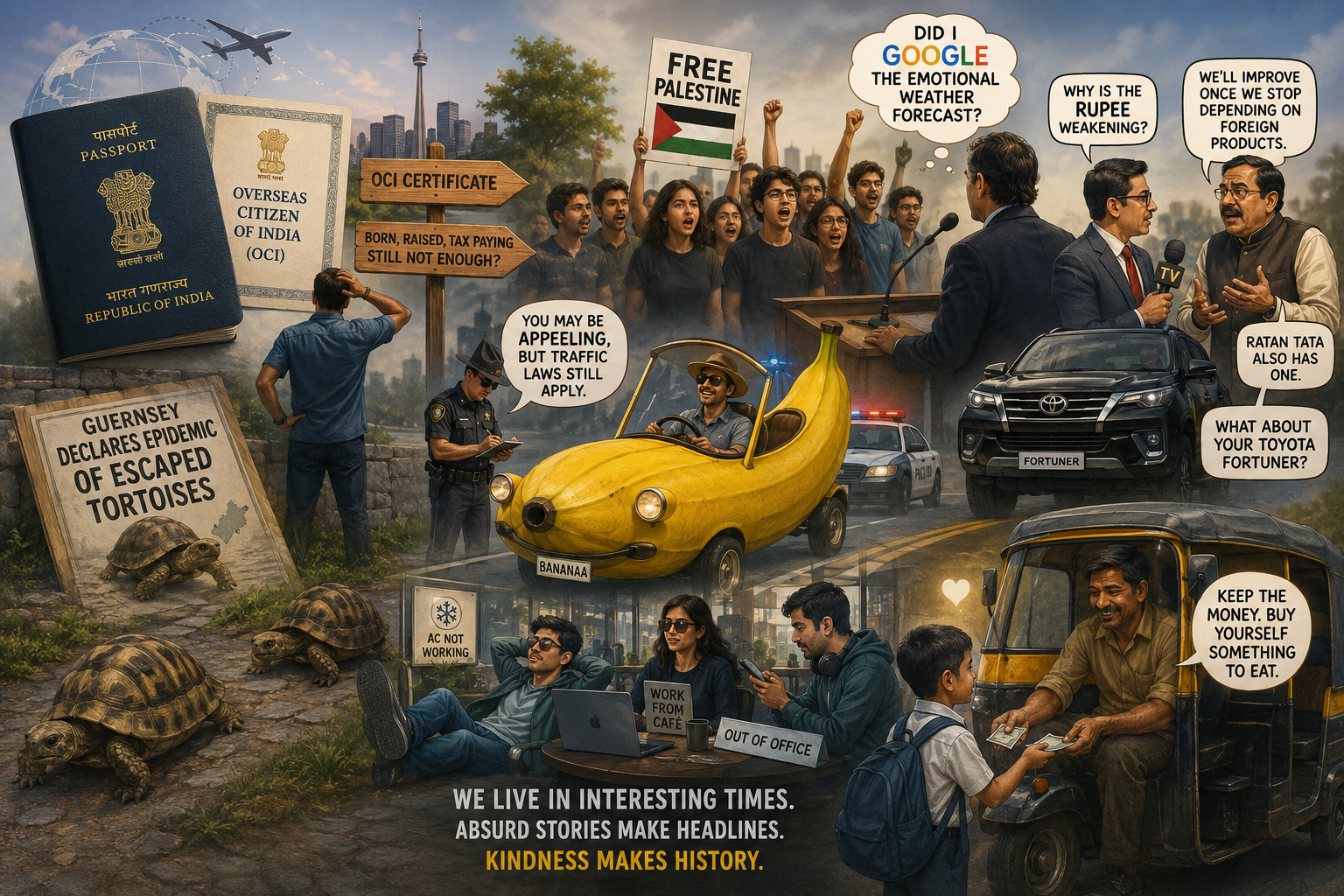
Take the simple question: Who is an Indian? For decades, the passport was regarded as the ultimate proof of citizenship. Silly us. It has been officially declared now that an Indian passport, though a very impressive travel document, in not conclusive evidence that its bearer is an Indian. The only people who seem to possess officially certified Indian-ness are Overseas “Citizens” of India (OCI). Think about that. A gentleman living in Toronto has a certificate affirming his connection with India, while someone born, raised and paying taxes in Tiruchirapalli must rely on the comforting assurance that the government “knows” who he is. It reminds one of the elder brother in the Biblical story of the Prodigal Son. His father tells him, “You are always with me, and everything I have is yours.” Which is wonderfully reassuring – until you ask for something in writing.
Perhaps, some day we shall introduce a certificate confirming that you are indeed yourself – which raises other existentialist questions but we will let that go…
Elsewhere, a Person of Indian Origin learnt the importance of “Googling” the emotional weather forecast before accepting speaking engagements. He entered the hall of his alma mater expecting nostalgic applause. At least. Instead, nearly two hundred students rose, chanted “Free Palestine” and walked out before he could begin.
Behavioural scientists may analyse the event for years. Marketing professionals will simply call it poor audience research. Artificial Intelligence can compose symphonies, diagnose diseases and beat grandmasters at chess. Yet nobody seems to have developed an app that quietly whispers, “Perhaps this isn’t your crowd.”
Speaking of misplaced confidence, one television interview deserves permanent preservation in the National Archives of Political Responses. Asked why the Indian rupee was weakening, a politician confidently declared that India’s fortunes would improve once we stopped depending on foreign products. The reporter then committed the cardinal sin of asking a follow-up question: “What about your Toyota Fortuner?”
The stuttering reply ended with the mother of all non-sequiturs: “Ratan Tata also has one.” Cause, effect and relevance occupy entirely different universes, apparently.
Meanwhile, human progress itself was represented in Montana by a speeding banana. Not a truck carrying bananas. Not someone wearing a banana costume. An actual banana-shaped motor vehicle that was stopped by the Highway Patrol – whose officers displayed admirable restraint. Their official statement observed that while the vehicle was certainly “apPEELing”, traffic laws still applied. One cannot help admiring a police force that enforces the law without resisting the urge for a respectable pun. While psychologists may call this an identity crisis (as in, everything going bananas), the rest of us call it America as it is evolving … it’s leadership being a major factor…
Not to be outdone, Guernsey, a 30-square-mile island in the English Channel, announced an epidemic of escaped tortoises. Only in creative journalism can the words “epidemic” and “tortoise” comfortably occupy the same sentence. Whether it was the heat of global warming (under that shell??) or of romantic pursuit, they crawled out of their enclosures. Which raises several uncomfortable questions: How exactly does one lose a tortoise? More importantly, how does one fail to catch it? Did the owner/keeper say: “He was here on Monday…” Evolution clearly over-estimated human organisational skills.
And evolution brought Generation Z. For decades, office-goers accepted that employment meant staying late to impress managers, and treating weekend calls as minor inconveniences.
Generation Z appears to have misunderstood these traditions completely. When office hours end, they leave. Calls on weekends, not answered. The air-conditioning failed? No sweat. The entire Gen Z contingent calmly relocated to a nearby café and informed HR that work would resume when working conditions improved.
An older millennial who marvelled at this astonishing arrogance, was devastated with the reply: “You put up with everything – and got used to it!” An entire generation! Collective emotional damage! Without realising what lack of air-conditioning can do to one’s psyche. Perhaps every generation inherits certain absurdities and accepts them as the norm.
Fortunately, it is the little sparks of humanity that remind us that we are not all going astray.
One little boy dropped his sister and another girl at school in an auto-rickshaw. When the driver discovered that the second child wasn’t related but had merely been offered a lift because she couldn’t find an auto, he quietly refused to accept the fare.
“Keep the money,” he said. “Buy yourself something to eat.”
No influencer recorded the moment.
No corporate campaign converted it into an advertisement.
It was simple kindness doing what kindness has always done – appearing quietly, taking no credit and disappearing before anyone could applaud. And yet, perhaps, this was the most extraordinary story of all.
Looking back over these few weeks, one wonders: has the world changed?
It has merely become better connected. A century ago, a runaway tortoise would have remained a village anecdote. Today it is international news before the tortoise has crossed the first garden. Overwhelming. Absurdity which always existed – has simply improved its outreach through Wi-Fi.
So yes, these are indeed interesting times. But “interesting” may be too mild a word.
These are times when bananas are ordered to “pull over”, tortoises tend to put the hares to shame, citizenship demands philosophical discussion, and ordinary kindness remains the rarest headline of all. If history is written (or re-written) by the victors, the stand-up comedian is not far behind.
