Kashmir of the 18th century.
The gurgling Lidder roared like a wounded lioness while smashing itself against boulders, cutting along the sharp and rough edges of its banks. The midnight hours were not for faint hearts. A nonchalant owl hooted somewhere from far across the thick Deodar trees. The prolonged ‘kirrrrr kirrrrr’ of crickets lent the nocturnal air an unsettling energy; the kind that makes your chest burn with anxiety.
Inside a dimly lit mahogany-wood cottage that stood at Lidder’s eastern banks, portentous silence hung heavy.
A few strands of hair.
Some illegible sentences and symbols on a small paper.
A man chanting in Kashmiri accent,
“ Adui umr tah bodui balái,” (Half life and great misfortune be to you.)
He quickly finished his business, with hands still shaking, locked the cottage and left the village forever.
***
The valley was bustling with the joy that the news of the queen’s pregnancy had brought that day. For six long years, King Adhiraj Singh and his kingdom had waited anxiously for their heir. The villagers feasted upon saffron infused shuftas that the royal kitchen had prepared for them as a celebration. One among them didn’t taste the dessert, instead, threw it away secretly with disgust.
As the queen entered her third trimester, the king ordered the best artisans of the valley to prepare the finest clothes, toys, bed, and shoes for the baby who was soon to arrive.
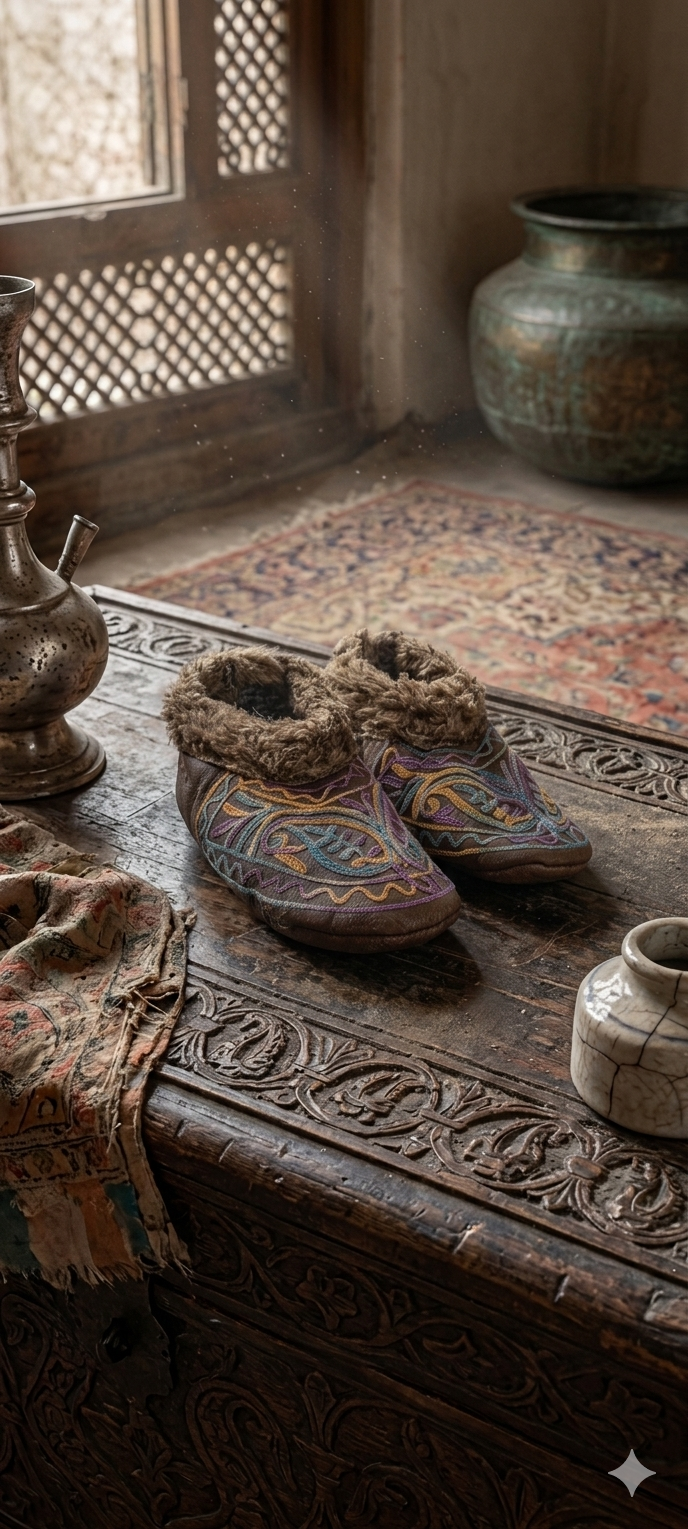
The exquisite range of extraordinary baby clothes and essentials filled the baby’s room. Along came the most bewitching pair of baby shoes. And a series of calamities.
Within a week, the king’s army lost their most crucial battle against a neighbouring state.
A man in a far away hut outside the valley heard the news and counted,
“First.”
The following week brought a massive landslide, the most devastating that the valley had ever seen.
The man watched from atop the hill and hissed,
“Second.”
The economy of the kingdom had dwindled, those who remained, began to leave the valley stating that the palace had borne something ominous on it.
The queen writhed in pain that night. The midwives did their best but the baby boy couldn’t be saved from the sinister umbilical cord knots around his neck. The queen, too, succumbed, leaving the king aghast.
The news reached the aloof hut. The man sat down on his knees like a defeated warrior, who had had enough. He murmured,
“Third.”
He cried for the first time in that one year of losing his wife and an unborn child. He bellowed, stretching his hands up towards the skies and fell on his sides with a thud.
The king had laid his lustful eye on his beautiful pregnant wife a year ago. She was summoned in the palace in the dark of one night under the pretext of assisting the queen for some urgent medical help, while the man was made to wait outside. Her refusal to the king’s licentious advances got her killed and thrown away in the river. The man was threatened to keep quiet or meet the same fate.
He chose silence.
And revenge that night.
The villagers now often heard king Adhiraj Singh repeating the line, “Aibo pêyiyo gaibich balái, manda chhih patah chhai khijálat.” (Be sure, your sin will find you out.) He had eventually lost his senses, renouncing his wealth and palace, he left for some unknown pilgrimage.
The man returned to the valley after four months when he heard that the belongings of the palace were either put on auction or for sale.
Though dusk was already setting in, the frenzy of buying the belongings of the palace at minimal prices was apparent in the village. Amid the commotion in the local market, he searched for them. Everywhere. Most ardently.
“They are not pulhoer, (straw footwear) brother. You have aari zari juttis in your hands. What if small in size, they are unique. No second copy of them has ever been made. Two thousand. That’s the last deal. Take them or leave them.” The man paid the money, held those little artistic pieces in his hands and went on hearing about the shoes from the local art patron.
The shoes that he had once crafted himself.
He caressed the soft velvet and remembered how he had chosen the most plush lamb leather to make them. He had stitched their inner linings so as to make them cushiony for the tiny feet. The choicest woollen and silken threads had gone into making the chenar leaf motifs on them. Along with it all, he had woven the evilest witchcraft into them that would bring three misfortunes to the owner of the shoes.
The touch of them purged him of the long held venom inside him.
He hugged them, kissed them, touched them on his head, and said a thousand sorrys with eyes crying a deluge of guilt and repentance.
He kept walking in a state of despondency. The shoes began to feel heavier by each step, their velvet started to impale his palms, the silken threads felt like they had grown roots into his skin and reached his veins.
He arrived at the banks of Lidder. It was eerily calm, as if it had been awaiting. The man looked at the shoes for one last time, and surrendered himself, his wrath, his guilt to Lidder.
The shoes kept afloat.