

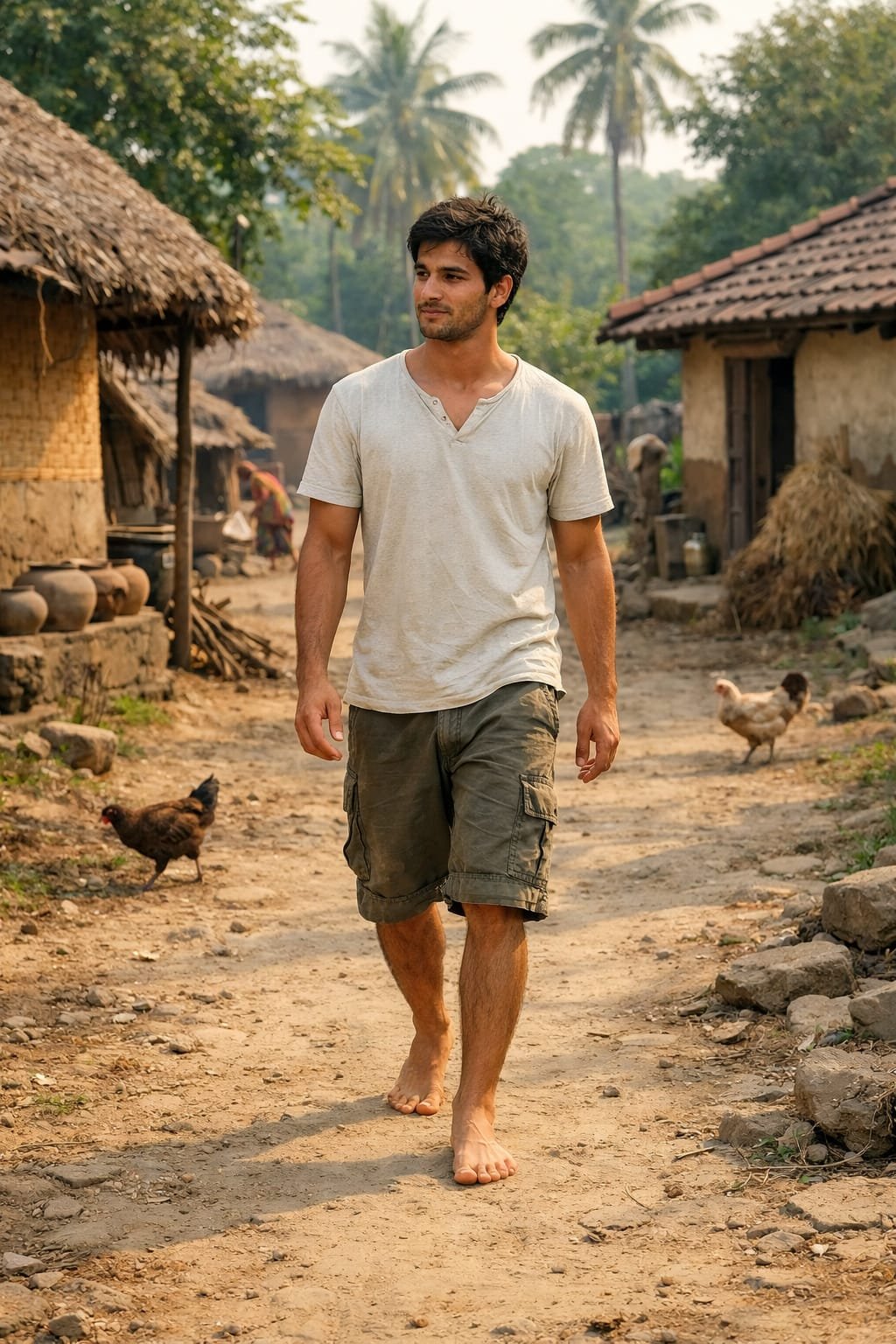
Chandragiri hills cradled Paadagramam in its arms like a mother embracing her newborn, the gurgling river on one side singing it to serenity. It was believed that the Goddess rose from the soil and dwelt there among the locals. There was one rule: in Paadagramam, no one walked with shoes; only barefoot could touch the soil. The rule was etched in the air. Unwritten, unseen but felt. It was believed that when their bare soles touched the soil, their bodies healed and minds relaxed, for they surrendered to the Goddess. Everyone adhered to the rule, some out of blind reverence while others out of fear.
On a rainy afternoon, boots thudded against the earth, the soil trembling under their weight. Water from the puddles splashed everywhere. The gurgling river paused, and a hushed silence spread across the land. The village froze as the young man trod, each step a lash against the earth.
“Stop, son. Remove your shoes and continue barefoot,” spoke Rajeshwari, the matriarch governing the village.
The man halted, looked at her, and said, “I can’t do that. I don’t want my feet to get dirty.”
Rajeshwari crossed her arms across her chest and walked slowly towards the man—her demeanour calm, like the sea, but her eyes fierce, like fire.
“This soil is pure. It’s your shoes that are dirty. This land is our mother, and we will not let you insult her. Remove your shoes, touch the soil, seek forgiveness, and then continue or leave the village,” she said, her voice slicing through the air.
“I’m not going anywhere. This is my home too. I’m here to pay my respects at my mother’s funeral,” he said, with his eyes lowered.
A woman whispered something into Rajeshwari’s ear.
“You are Lakshmi’s son, Vijay,” she said, her voice trembling under the weight of sorrow.
Lakshmi—Rajeshwari’s close friend who often helped govern the village—shared with her the ache of living alone. She longed to meet Vijay for one last time. But he never came, and now he was here, after everything had come to an end.
“I must go home,” he said, tears shimmering in his eyes.
“Your mother’s last rites have ended. Your friend Ramu lit the pyre,” she said, her words cold.
He stood still for a few moments, tears streaming down his cheeks, unrestrained, then trudged towards his home.
“Remove your shoes, Vijay. You are a son of the land. You must know better than to disobey the rule,” she said, carrying herself with the authority of a village head.
He removed his shoes in a daze and walked away, his silhouette growing fainter as the sky turned orange. He was home but didn’t feel at home.
The next morning, Vijay noticed his shoes were missing. He searched the surroundings and, upon not finding them, stormed over to Rajeshwari’s house.
“I can’t find my shoes. Someone must have stolen them,” he said, his eyes still red with dried tears.
“Here, no one will ever touch your footwear. We don’t need them,” she replied.
“How will I walk around?” he asked.
The same way you did now, she said, smiling.
He looked at his earth-kissed feet, a wave of disgust washing over him. He hurried home and washed his feet until all traces of mud were gone.
A week passed. He stayed indoors. Neighbours brought him food, but being confined in an empty house gnawed at him. He needed to return to work. His head ached, and he felt lethargic, losing his vitality.
The morning rays filtered through the windows, embracing him. A wave of warmth flowed within. He opened the door and crossed the threshold.
Unintentionally, he stepped onto the soil barefoot. The coolness seeped through his skin, filling him with a calm he had never known before. A pebble made him flinch, but he kept walking. The scattered stones worked like acupressure points, while the earth’s touch soothed him. Temple bells rang faintly in the distance. He watched children play the game of seven stones. A marble landed near his foot and, instinctively, he joined their game. An hour later, he was soaked in sweat, his clothes soiled, but his heart felt cleansed.
Two weeks passed. He noticed the blisters on his feet had vanished. Over the past two years, he had tried various treatments, but all in vain. Paadagramam’s soil was magical. The air was pure, the soil cathartic, and the village was a sanctuary. Everything good came to an end, and so did his stay.
Two days later, he knelt on the ground, touched his forehead to the earth, offered prayers, and packed a fistful of soil carefully.
“I lost my mother, and that pain will never fade. But I have found myself. Calmness has settled deep within me. This soil is pure and so are your souls. Thank you for guiding me to follow this rule,” he said, touching Rajeshwari’s feet.
She placed her hand on his head and handed him a bag. Inside were his shoes. He smiled, placed them in his bag, and continued walking barefoot. The horizon turned golden yellow, as the light spread everywhere. Rajeshwari remained rooted, her gaze following him until he disappeared into the distance. The little-boy-turned-young-man finally found his roots, his home, in the soil of memories and his heart belonged in the stillness.
“Did the earth return his shoes?” a girl asked.
There were many theories about the missing shoes. Some said the earth had swallowed them; others claimed the Goddess had taken them away. Some believed stray dogs chewed them.
Rajeshwari looked at the girl, softly caressing her hair, a smile on her lips, her eyes shining with mystery.


