

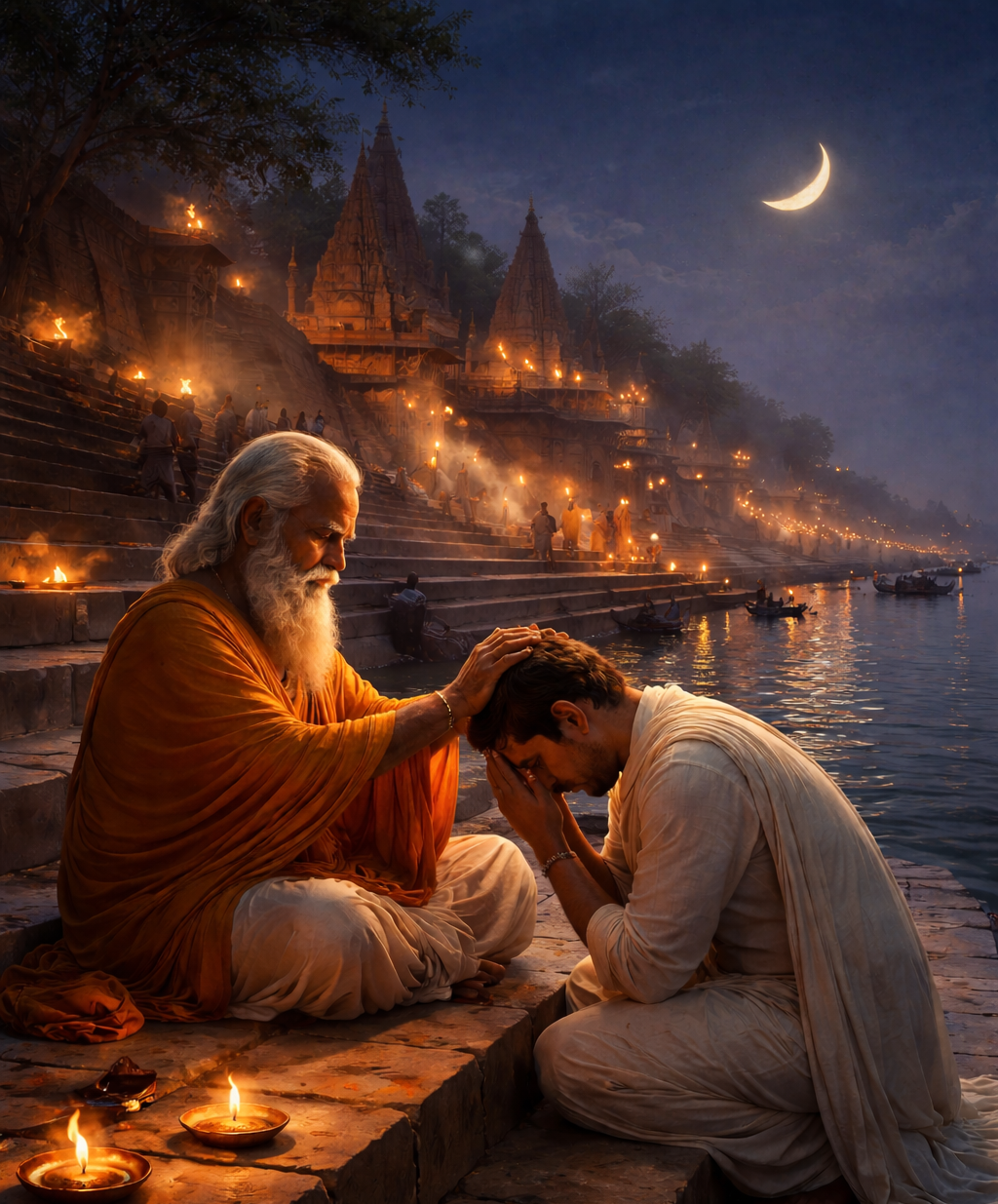
The moon hung like a silver hook over the Ganga, casting a shimmering path across the dark, pulsing water. On the stone steps of Kedarnath Ghat, Anand sat beside his guru, Brahmanand.
“Gurudev, wouldn’t it be wonderful if we could view our past lives?” he asked.
“Why sift old ashes, Anand? The whole purpose of a spiritual path is to live in the present. Nature has designed us in a way to forget past identities, so we are not burdened by them and can start afresh,” Brahmanand replied, attempting to dismiss Anand’s curiosity.
“But Gurudev, it can help us learn why and how we came to be what we are in this lifetime,” Anand persisted.
“If nature wants us to know, it will be revealed to us naturally. Spiritual advancement is not about accumulating siddhis; it’s about letting go.”
Anand felt disappointed. A flash of arrogance, disguised as a quest for truth, rose in him. “Or perhaps, you are afraid that if I see the past, I might see something you don’t want me to see? You want to hide something from me?”
Brahmanand turned slowly. He looked calmly at Anand with compassion. “I’m hiding nothing, Anand. The past is already gone; it no longer affects me. But it might affect you. However, if you so insist on looking into it… let it be.”
Brahmanand reached out and pressed his thumb firmly against the space between Anand’s brows.
The world outside remained the same, yet for Anand, it dissolved. The cold stone of the ghats vanished. The sound of the Ganga was swallowed by the haunting, melodic whine of a sarangi and the rhythmic chimes of ghungroos.
Anand opened his eyes within the vision. He was in a lush courtyard draped in gold-threaded silks. The air was thick with the cloyingly sweet scent of musk and crushed jasmine. He looked toward a polished bronze mirror and froze.
There, reflected in the metal, was a woman of incredible beauty. Her eyes were lined with kohl, her lips stained the colour of crushed hibiscus. She was a Ganika, a celebrated courtesan of ancient Kashi. As she turned to welcome a man, Anand felt a jolt of recognition that made his soul recoil.
The eyes.
Even through the makeup and the jewels, the eyes were undeniably those of his guru. He watched as the woman held the stranger. She offered her body and presence with serene, compassionate attention, listening to the man’s shames and his failures, receiving him with a warmth that didn’t judge his motives.
Anand snapped back into his body at the shock. The return jolted him, causing him to lose his balance. Instinctively, Brahmanand reached out to catch Anand’s arm to prevent him from tumbling into the river.
But Anand resisted his touch. He scrambled away, still trembling and gasping in shock and disgust. His face twisted and his eyes filled with revulsion. He distanced himself from his master.
Brahmanand looked at him calmly, and then at his own hand that remained extended in the space between them for a moment before he slowly withdrew it.
“So, you think my touch has become impure because of what you saw?”
“You… you were a courtesan! I saw you in the gutters of this very city. You were selling your body. How could you? I have spent my life striving for purity, only to find my guru was… that,” Anand cried as he spoke.
Brahmanand did not recoil. He sat unmoved but spoke gently.
“Anand, what disturbed you more: the life you saw, or the judgment it stirred within you?”
The question landed deeper than the vision itself. Anand lowered his gaze.
Brahmanand continued, “Purity isn’t merely about distance from certain things, people, or choices. Look at the Ganga; she accepts saints and sinners alike, embracing them without judging them. In the life you saw, people came to me without pretense. They did not hide their desires, their loneliness, or their wounds; they came as they were. And I accepted them, without judgment. And now, people come to me here on the ghats again with desires, though differently shaped, the same loneliness, the same wounds, only now, they are better disguised behind prayer beads and holy ash. And they, too, are received without judgment.”
A heavy silence fell between them.
“Don’t worry Anand, I too was once like you, and that life taught me unconditional acceptance, somehow preparing me for this one. The peace I once delivered by embracing bodies for money, I now deliver by embracing their spirit to keep compassion alive.”
Anand felt something crack inside him. It was the brittle shell of his own “purity,” a wall he had built to feel superior. He realized the shallowness of his own ideas against the depth of the vision that Brahmanand had offered.
Anand looked up, his anger mellowed as he spoke, “I spent all these years sitting near this river, but only today I learned why they call Ganga the symbol of purity.”
With tears blurring his vision, Anand fell at his guru’s feet. With trembling fingers, he took the very hand he had just shunned and placed it upon his head.
The bells of the evening aarti faded, leaving only the sound of the river, ever present in the moment, flowing millions of pasts into the heart of the ocean.
WORD COUNT: 895 words including the title.


