

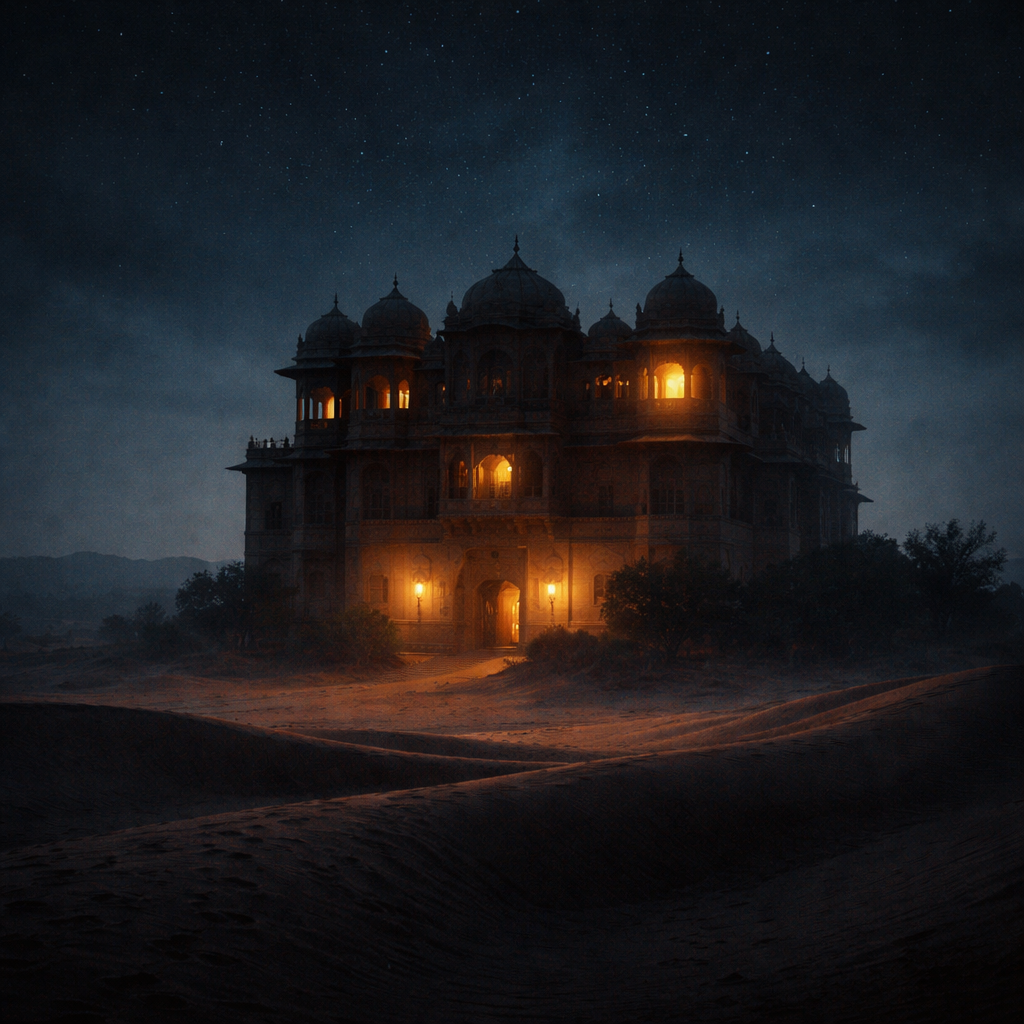
It happened during my search for a story. I was in suburban Rajasthan when, one night, I sat outside my guesthouse, irritated by the absence of an idea. My first film had been a commercial success—story, music, cast, everything aligned. This time, I wanted something different. Not bigger. Just sharper. The sky was unusually still that night. I began walking without direction, following a dim road that curved away from the town. That was when I saw it—a citadel standing apart from everything else, lit but unguarded, as though it expected visitors. I knocked on the antique lion-headed door. A man dressed in an embroidered robe opened it. He carried himself with quiet authority. “I am looking for a location,” I said. “I’m a director.” “I wouldn’t mind showing you the house,” he replied, “but I would like to see how worthy your script is.” The script did not exist. “You don’t have a story,” he said—not unkindly. I did not. “Then let me offer you one.”
——————————————————————————————————— “Not very long ago,” he began, “there was a crisis in the dark world.” The spirits had run out of space. Modernisation had erased silence. Graveyards became construction sites. Tombs became playgrounds. Marriage halls roared through the night. Even fear had been commercialised. No one left room for the dead. So they migrated. They drifted from city to city until they reached the desert, where silence still lingered between dunes. Some dissolved into sand. Others discovered this abandoned palace. But not everyone could stay. A panel was formed—spirits from different eras, chosen for their experience in haunting. There was Mr. Chaudri, a former court judge from the British era, known for his fairness in life and his silence in death. Banshidhar, once a minister in King Abanindra’s court, who had abandoned his tomb when a skyscraper rose above it. And an actress, long forgotten by an industry that had moved on too quickly for mourning. Together, they decided who would be allowed to inhabit the palace. A rock musician who promised entertainment passed. A servant passed for his diligence. An architect. A soldier. A freedom fighter. A cabaret dancer who pleased the old judge with her grace. The rest were asked to leave. For a while, the palace held them all. But even that vastness began to feel insufficient. Disputes arose—over silence, over comfort, over light. Even eternity can feel crowded. Then one day, a man entered. He swept the palace. Opened its windows. Let in light. The spirits tried to haunt him. He smiled. They whispered. He slept. They rattled chains, flickered lamps, summoned wind. He turned up the music. And gradually, the palace felt smaller to them. Brighter. Less theirs. One by one, they left. All except the dancer. Rumour has it they fell in love. But no one knows the truth.
He stopped there. “That’s a good story,” “I realise I never asked your name,” I said. “Jorawar.” “Do you live here alone?” “With my wife,” he replied. As I walked back toward the road, I glanced at an upstairs window. Two shadows moved behind the lattice. Bangles chimed. Anklets answered. Near the gate stood a stone plaque: Jorawar Palace. Built in 1419. I never returned. But I sometimes wonder whether the palace did not lose its ghosts. Perhaps it simply made room for one more………


